Encounters
 |
| Hiraizumi |
As a school kid I realized that one can paint meaning onto life: cartoons, history books, new stories.
I could be not only Actarus longing for his life on Vega, but also Schliemann discovering Troy, Konrad Lorentz having new ducklings imprint on him.

I am now looking at the Sendai skylight — out of the windows of room 507 of the International House Sanjo 2. A lot of blinking red lights on high-rise buildings.
Almost too much meaning to take in.
 |
| Picture by Jeroen |
Where does meaning come from?
 I dare say from 'encounters'.
Not only the ones with friends I will keep for life.
 Think of the cashier when you handover a 10.000 yen bill. If you give a 100 euro bill to a Dutch cashier, if they accept it at all, they will roll their eyes at the inconvenience you have put them through. The Japanese cashier will accept it with two hands, and state how much you gave them. They will take the change from the counter, make a move as if they would do a prestige trick with cards and make a sound with the bills; they will count them making sure you have all your attention pointed at their counting. They will hand over your change, bills first. Then they will place the coins on top of a 'tray' made by the receipt. They will smile and thank you. Since you must be psycho-physically involved in this dance, you cannot fail to have encountered them.
 |
| Hiraizumi |
 |
| Dogen |
 Times are made of 'kyoryaku' 經歴, which I visualize as encounters. Encounters with oxygen that makes me breathe, that rusts my bicycle, that dries my skin. Gereon Kopf writes: "We are who we are and who we will be in relation to real and imagined others". Encounters with people, dead or alive that produce meaning proportionally to the attention and care that is involved in each encounter. Care in re-reading a sentence. Care in looking into each other's eyes while speaking. Care in drying up your body before going to the locker room.
 Yes, I am the proud member of a swimming pool. All moments and all gestures are thought about. Nowhere is wet on the floor where you might have socks on. Nowhere is cold where you are naked or wet. At every stage of the process there is always a little tray or a little hook or a small centrifuge, where you can store, dry, hang up your stuff and be ready to do completely whatever you are doing — changing, swimming, showering, relaxing in the hot bath and then waking up in the cold one, drying up your body, drying your hair, putting on your clothes. Encountering water, encountering dry towels. Encountering my body as something worth of so much care.
I feel so embedded. It's like being in a car when Jeroen is carefully driving.
 My life in Japan is teaching me that care yields meaningful encounters.
 |
| Geibikei Gorge |
 |
| Hiraizumi |
Peter Hershock (Valuing Diversity, 2014: 90) talks about 'relating-freely' in terms of "an 'infinite game' in which the point is not winning, but rather enhancing the ongoing quality of play experienced by everyone involved." It is about encountering the other freely —rather than being preoccupied with our own identity, with giving a good impression, with finding out whether we like or dislike the other. It is not about us and them.
It is the in-betweenness taking over.
Dōgen says
經歴はそれ時の功 なるがゆゑに。古今の時、かさなれるにあらず、ならびつもれるにあらざれども、 原も時なり、黄檗も時なり、江西も石頭も時なり。自他すでに時なるがゆゑに、修證は 時なり。入泥入水おなじく時なり。(Shōbōgenzō, Uji)
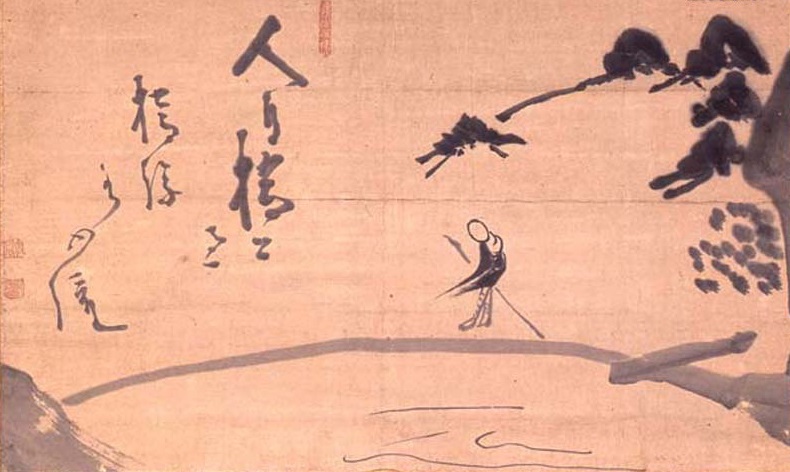 "Because encountering is the virtue of time, times of past and present are neither piled up one on top of another nor lined up in a row; and, for the same reason, Seigen is time, Ōbaku is time, and Kōzei and Sekitō are time. Because you-and-me already are time, practice-and-experience are various times. Going into the mud and going into the water, similarly, are time."(Nishijima and Cross adapted)
 |
| Iwate - rice fields |
Time consists of encounters.
I consist of encounters.
But this is no more about me.
It's about continuous, transformative, in-betweenness.
And what is really new for me is that in-betweenness is made of gestures.
Enrico introduced me to Hakuin's poem
"Yesterday morning I swept out the soot of the old year;
Tonight I pound rice for the New Year goodies;
There's a pine tree with roots, and oranges with green leaves—
I put on a fresh new robe to await the coming guests."
My time in Japan is teaching me that free, real encounters spring out, not only from openness to the guests that might come, but from careful gestures.


Comments
Post a Comment