Shallow roots
 |
Are there deep roots I had to cut before leaving? No.
Do I feel uprooted? Not at all! I don't miss a single thing.
Do I feel at home? I don't know. Do I ever feel at home?
What might that mean?
 |
| Sendai - morning walk to the school bus |
Let's try: home might mean language, food, landscape, energy of people.
Food, landscape, energy of people: I feel at home in Japan.
Language - I understand a word every 3 sentences: not home.
Could I live here? I think so, once I learned the language.
Will I miss Japan when I am not here? For sure.
 |
| TeamLab Planets Tokyo |
 |
| TeamLab Planets Tokyo |
Kindness, Gratitude —and other values related to the ability to perceive the other— can absolutely thrive here, even if they need some adjustment when dealing with Japanese people. For instance, I usually look at people in the eyes to really perceive them, which is regarded as rude. While I am writing this sentence I suddenly wonder whether I can perceive the other without looking at them. Perhaps looking at them is especially important to signal that I am perceiving them rather than to perceive them.

Hhm. The Japanese way to show that they have perceived you is much more sophisticated. They will for instance remember if you put sugar or not in your coffee; they will remember what you like or dislike, without asking you twice. They know how to make you feel good. I can work on this.
Gratitude is easy. But this example shows gratitude to Marco, an Italian colleague from La Sapienza, who over an espresso tagged 'the best coffee in Seattle', gave me the most precious tips for 2 days in Tokyo with Isabella and Jeroen. First cold and rainy day at the TeamLab Planets (Toyosu) and second sunny day at Harajuku to explore the world of Kawaii.
 The weekend in Tokyo with my family also shows other core values, Warmth and Embeddedness. I need to feel connected, embedded — which I do, not only with Jeroen and Isabella with whom it is delightful to share the growth of our shallow roots and fancy that we could live anywhere, but also with my Mom and Dad who are the first to hear of our adventures thanks to the wonders of whatsapp (video-)calls; and our lovely friends who answer our text messages and mails and react to my posts at different times according to their time zones (and their sleeping habits!).
 |
| Ohara Koson, Wild Boar |
There I met a master who showed me what I am missing: peace of mind. It is a wild-boar by Koson.
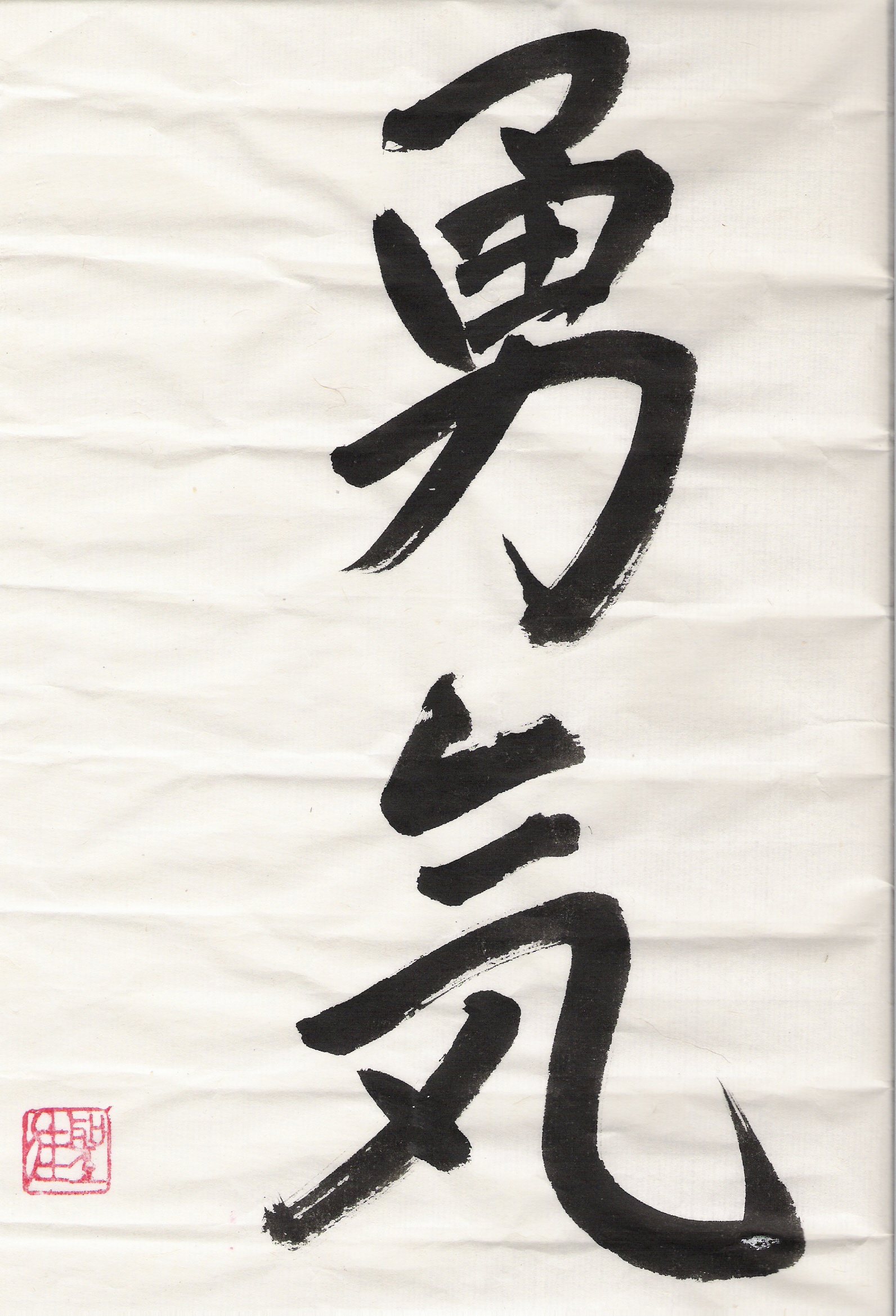
He seems not to miss my most important values: Courage and Overview.
While he sits there, so grounded in the snow and peaceful, overviewing everything, ready to act in perfect harmony without overplanning —my courage and my overview are fighting so hard with each other giving me a couple of very bad headaches.
You might ask: How can these values be so much in conflict?!
 Courage could manifest itself in eating sea-cucumber, with its texture similar both to a bone and to rubber, typically prepared in a vinegary dressing. And Overview consists in seeing how things relate to each other and to their context; being aware of the background against which we see them. An obvious consequence of Overview is not believing that things should be done by all the way I do it, for instance letting sea-cucumbers alone. This is pretty compatible with eating sea-cucumber once in a life-time. So far so good.
Another consequence of Overview is being aware of the effects of my actions and words: never just saying something without knowing what effect I want it to have, and never choosing something without knowing what I good I have in mind that will come from it.
Here things become tricky.
 Courage says: "you took 20 Japanese lessons with a lovely teacher in Amsterdam, you learned 100 kanji on your own. This is your golden chance. Who cares if you need to study 2100 more kanji to consider yourself a beginner, then starting to learn the 20 different pronunciations for each kanji? Who cares if yesterday, during my first private Japanese lesson, my teacher could not hide his surprise at my very low level ("What?! You took 20 lessons?! But how comes you speak so hesitantly?! But how many hours?! How many students?! How much percent of the class was devoted to practice?!"). Grab the chance! Every word you'll learn will do wonders on your roots... and needless to say, in 10 years and some study of Classical Chinese you might be able to read Dogen!!"
Overview says: "What is exactly the plan here?! Shall I remind you of what you have done the last month so that you can see for yourself that there is NO time for studying a language: gave 1 lecture; finished and revised a co-authored article on Plato and Buddhism; completed yearly report for UCU; submitted phase 2 proposal of a level 3 course I hope to be teaching in the Fall on Identity Construction in East Asia to the UCU Board of Studies;

What would the wild boar say?
 |
| Akihabara - Tokyo |
 |
| Sendai |
"In between roots that are too deep and roots that are only habits from some other place or time that do not sink in, are the quick growing shallow roots I advocate for contemporary Confucianism and Confucians. Ars contextualis means first finding out what the context is and how it differs from the contexts of our inherited ritual practices and virtuous arts of ritual playing. Bear in mind that our ritual habits of discernment and analysis themselves need to be under constant attention and modification to new conditions. Then in the new situation Confucians need to discern just how ritually to engage the natural environment, the social institutions, and the people with whom we interact. Roots should be sunk deep enough to effect that engagement so that the rich texture of civilized life can flourish as best as possible." (Neville 2017)


Comments
Post a Comment